
Long before Kawah Ijen became a visitor attraction, it was a workplace. Men from the villages around the plateau have worked in the crater for generations, breaking solid sulphur from the vents beside the acid lake and carrying it up to the rim and down the mountain on their shoulders. Visitors who climb to the crater at dawn share the path with them. This story explains what the work involves and how to behave around the people who do it.
How the sulphur forms
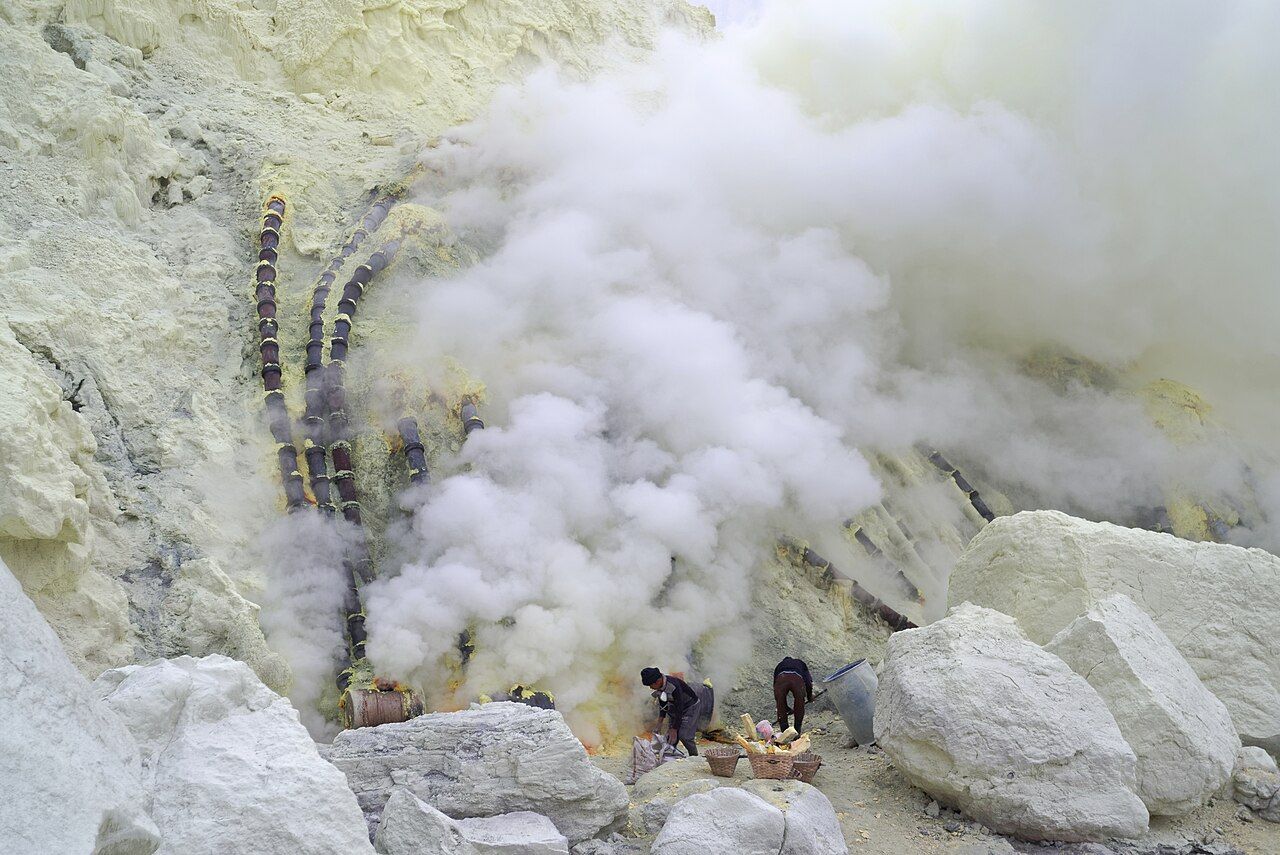
The vents on the crater floor release hot, sulphur-rich gas. To collect it, workers have fitted networks of pipes over the vents. The pipes guide the gas downslope so that it cools and condenses, and the sulphur emerges as a hot reddish-orange liquid. As it cools it hardens into the bright yellow rock that gives the crater its colour.
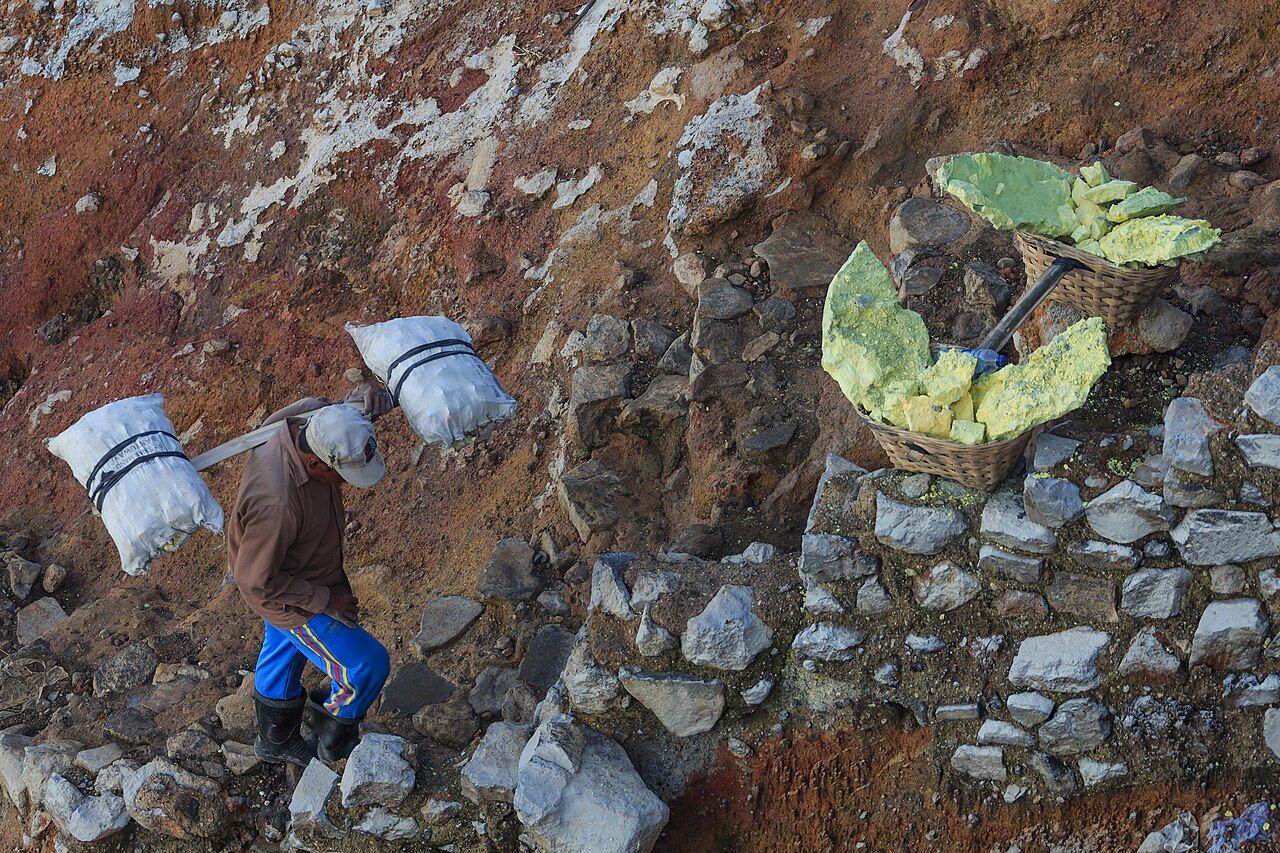
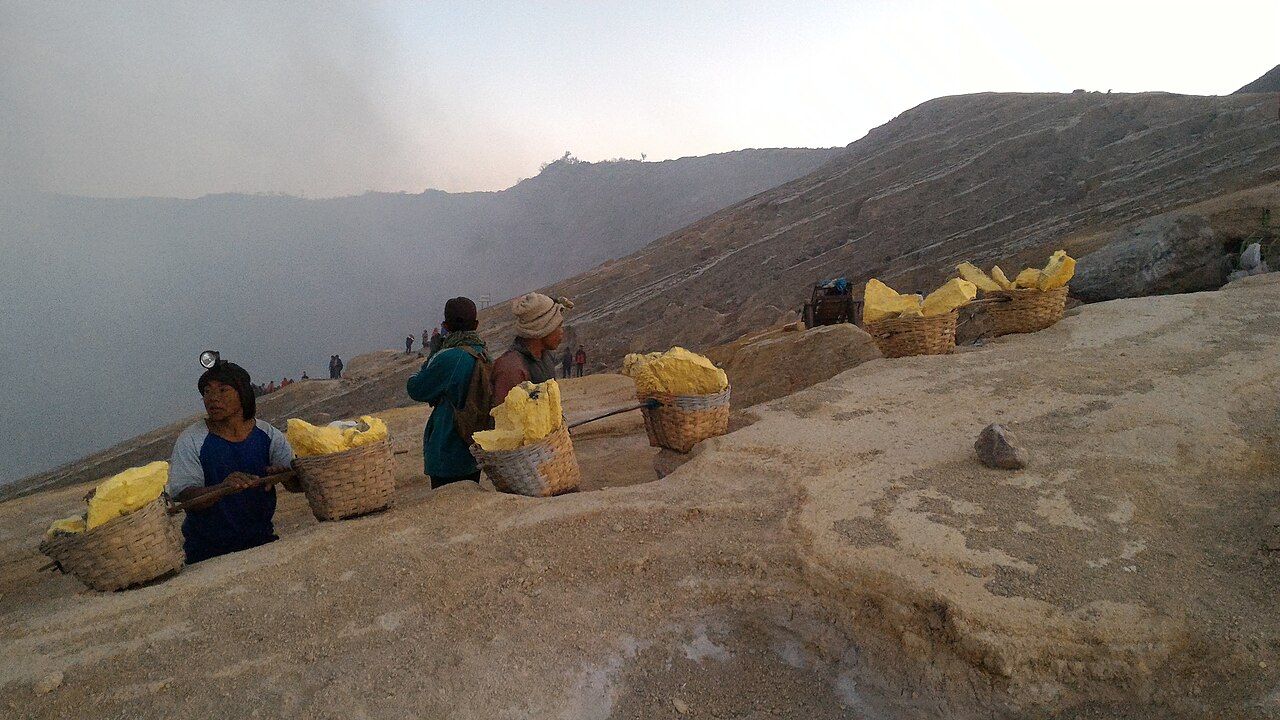
The workers then break the hardened sulphur into pieces with iron bars, load the pieces into a pair of baskets and lift the baskets on a pole across their shoulders. The work goes on in clouds of gas so dense that the person next to you can vanish from sight. Many workers have no more than a damp cloth held between their teeth for protection, though some now have proper masks.
The sulphur that leaves the crater is sold for industrial use. It is a small operation by the standards of modern mining, and in many respects it has changed surprisingly little over the decades.
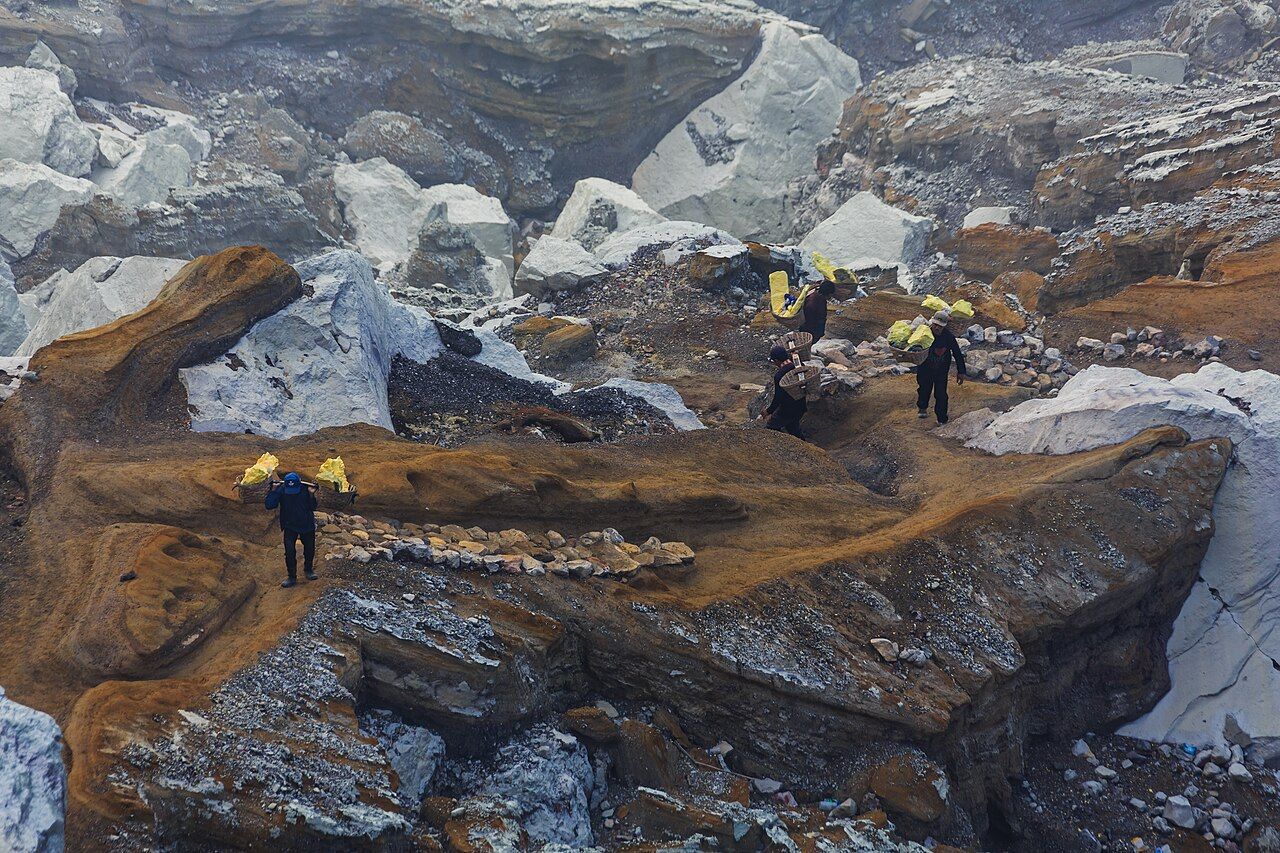
Watch the crater floor for a while from the rim and the pattern becomes clear. Small figures move between the yellow mounds beside the vents, disappear into the smoke, and reappear with their baskets full. Some work at the pipes, clearing blockages or adjusting the flow, while others break and load. The rhythm depends on the wind: when the plume swings across the work area, everyone stops, crouches or retreats until it passes, then goes back to work. It is a reminder that the crater sets the pace, not the people in it.
The loads and the path
The heaviest part of the work is the carrying. Loads commonly weigh as much as the man carrying them, and sometimes more. The route climbs from the crater floor up a steep, rocky path to the rim, then descends several kilometres to the collection point below, where the sulphur is weighed and the carrier is paid by weight. Strong workers may make the round trip more than once in a day.
The carrying pole presses deeply into the shoulder, and many carriers have permanent calluses or misshapen shoulders from years of work. The path out of the crater is the same one that visitors use to reach the blue fire, which means that tourists and workers move in opposite directions on the same narrow, uneven track in the dark.
In recent years, wheeled carts have taken over some of the downhill work on the wide path from the rim to Paltuding. Many of the same men now also offer to pull visitors up the trail in those carts, which has become another source of income. If you use one, agree the price clearly before you set off, and remember that the person pulling it is doing heavy physical work.
Health and risk
Working in sulphur gas every day takes a toll. Breathing difficulties, eye problems and damage to the teeth and lungs are commonly reported among workers. Accidents happen too: the gas can be overwhelming, the ground near the vents is unstable, and the path is hard on the body even without a load. The crater is also an active volcano, and its moods affect the workers before anyone else.
On the same journeyGas, cold and the crater: staying safePeople take this work because it pays better than many other options open to them in the area. Some come from families where fathers and uncles did the same job, and some combine it with farming or other seasonal work on the plateau. Numbers in the crater have varied over the years with the price of sulphur, the state of the vents and the arrival of other ways to earn a living from visitors. That is a reason for respect rather than pity. They are skilled at what they do, they know the crater intimately, and their knowledge of the wind and the gas is often better than any guidebook.
They are skilled at what they do, they know the crater intimately, and their knowledge of the wind and the gas is often better than any guidebook.
How to behave as a visitor
The crater is a workplace first. A few simple rules make a real difference.
- Give way. On narrow or steep parts of the path, step aside and let carriers pass. They are carrying heavy weights and cannot stop easily.
- Do not block the path. Stand clear of the track when you stop to rest or take photographs, especially in the dark.
- Ask before photographing. A person carrying sulphur is not a scene laid on for visitors. Ask first, by gesture if language is a barrier, and accept a refusal without fuss.
- Keep your mask on and your distance near the vents. If you are overcome by gas, you become a burden on people who are already working hard.
- Do not pose with workers' loads or try lifting a basket for a picture unless you are invited to.
- Be wary of being sold sulphur souvenirs only out of sympathy. Buy small carvings if you want one, but do not feel obliged.
- Keep your voice down near the vents, where workers need to hear one another.
Some visitors want to give something back. If you do, small amounts of money, food or water offered politely are appreciated, but do not turn it into a show. Never give anything in exchange for a photograph you have not been invited to take.
Photographs with consent
The sulphur carriers of Ijen have been photographed thousands of times, and some of the images are powerful. But many of them were taken without asking, and some workers have grown tired of having lenses pushed in their faces while they labour. A photograph taken with consent, after a word and a smile, is a better picture and a better exchange.
Wide shots that show the landscape, the smoke and the scale of the crater, with people small in the frame, often tell the story more honestly than close-ups. If someone agrees to a portrait, keep it brief, thank them, and move on so they can return to work.
The broader crater visit, from the night start to the sunrise view over the lake, is described in the guide to Kawah Ijen, and the flames on the crater floor are covered in the story on the blue fire. Both are linked to this work: the same vents feed the flames and the sulphur, and the same path carries visitors in and loads out.
Photographers on the rim
- Jakub Hałun, CC BY-SA 4.0
- CEphoto, Uwe Aranas, CC BY-SA 3.0
- CEphoto, Uwe Aranas, CC BY-SA 3.0
- Aditya Suseno, CC0