
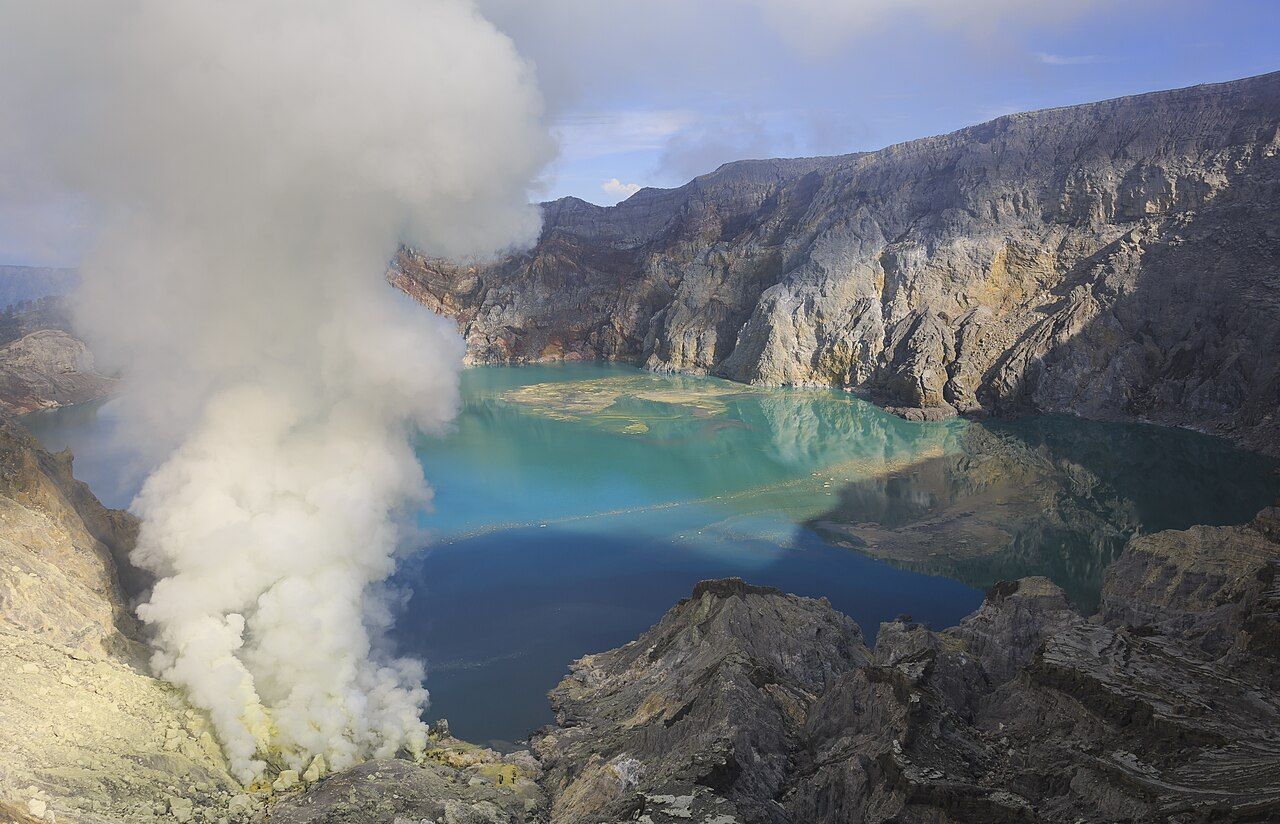
Most people meet Kawah Ijen in the dark. The walk begins at night from the trailhead at Paltuding, climbs through cold pine and casuarina forest, and reaches the crater rim while the sky is still black. Then the light comes up and the crater shows itself: a wide bowl of pale, scoured rock, a lake the colour of glacial meltwater, and a column of white sulphur smoke rising from the far shore. It is one of the strangest views in Indonesia, and it rewards the effort of a very early start.
This guide covers how a visit usually unfolds, what the lake actually is, how to deal with the gas, and why you should never take the opening of the crater for granted.
A volcano inside a larger one
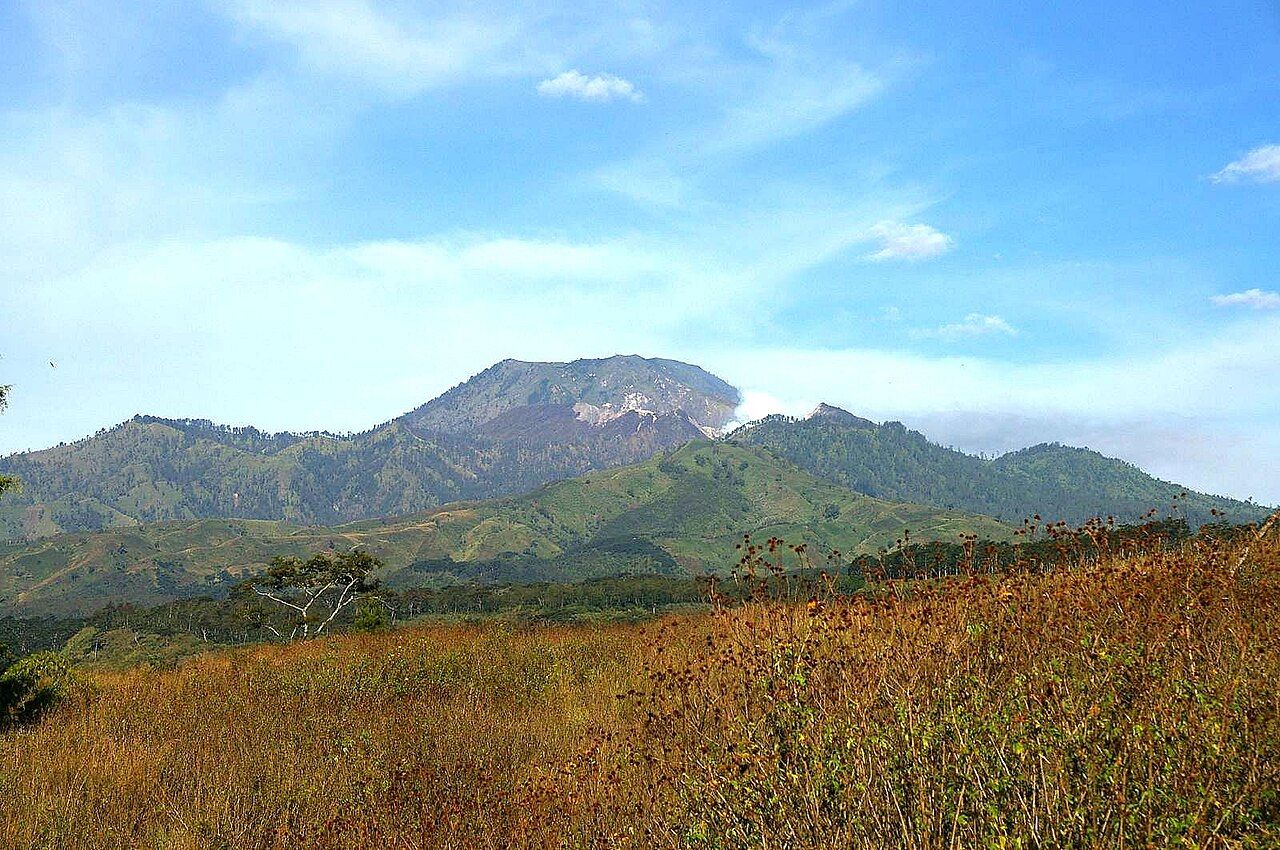
Ijen is not a single mountain but a cluster of cones standing on and around an old caldera that spans much of the plateau between Banyuwangi and the interior of East Java. Kawah Ijen is the active crater near the eastern edge of that old structure. To the east of it rises Gunung Merapi, a separate and quieter peak that shares its name with the far more famous volcano in Central Java; to the west, across the plateau, stands the much larger cone of Mount Raung.
The crater itself is steep-walled, roughly a kilometre across, and holds a lake that is often described as the largest strongly acidic crater lake in the world. Its water carries dissolved sulphuric and hydrochloric acid, which is what gives it that milky turquoise colour. It is not water for touching, let alone swimming, and the rocks along its edge are stained and eaten away where the acid has worked on them.
The night start from Paltuding
Visits are timed around darkness for two reasons. One is the blue fire, the burning sulphur gas at the bottom of the crater that can only be seen properly before dawn; the blue flames have their own guide on this site. The other is simply that the rim is at its clearest and coolest early in the morning, before cloud builds over the plateau and the sun makes the climb hot and dusty.
That means a very early departure. Most visitors drive up the plateau road in the middle of the night, register at the ranger post at Paltuding, and wait for the trail gate to open. Opening times, registration steps and entry fees are set by the park authorities and change from time to time.
The path from Paltuding to the rim is a wide, sandy track of roughly three kilometres. The first section is gentle, the middle is steep and steady, and the last stretch eases off as you approach the crater edge. Fit walkers usually take somewhere between one and a half and two hours at a calm pace. There is no prize for speed: the air is thin enough at this height to make you short of breath, and pacing yourself is the better choice. The trail from Paltuding is described step by step in a separate story.
On the same journeyGas, cold and the crater: staying safeGas, masks and the wind
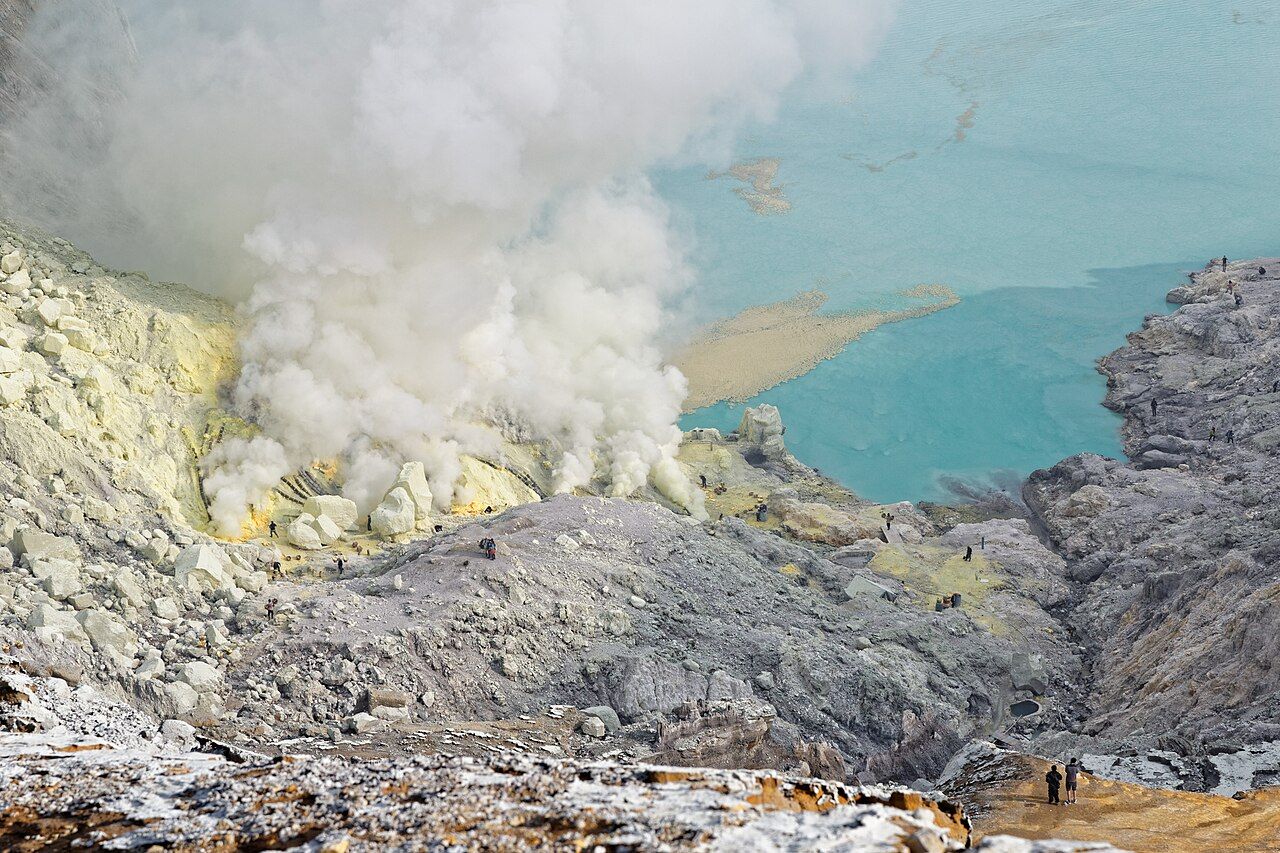
The single most important thing to understand about Kawah Ijen is the gas. The vents on the crater floor release sulphur dioxide and other gases in a dense plume, and where that plume goes depends almost entirely on the wind. On a still morning it rises in a straight column. When the wind shifts, it can roll across the rim path or down into the crater in seconds, and the smell turns from a faint whiff of struck matches into something that makes your eyes stream and your throat close.
A proper gas mask with filter cartridges is essential, not optional. A cloth face covering or a paper dust mask does very little against sulphur dioxide. Masks are often available to rent near the trailhead, but check that the filters are in usable condition and that the seal fits your face before you set off. People with asthma, heart conditions or other breathing problems should think carefully about whether to go at all, and should speak to a doctor first.
Where the plume goes depends almost entirely on the wind, and the wind can change in seconds.
Where the plume goes depends almost entirely on the wind, and the wind can change in seconds. If the gas reaches you, turn your back to it, stay low, keep your mask on and move calmly upwind or away from the plume. Do not run on the loose ground near the edge. Follow any instruction from rangers without argument: they see this crater every day and know its moods better than any visitor.
The rim at sunrise
Once you are on the rim, the walk around the edge offers several viewpoints over the lake. As the sky lightens, the colours come through slowly: first the grey of the crater walls, then the yellow crusts of sulphur near the vents, and finally the full turquoise of the water. On a clear morning you can look back west to the cone of Mount Raung standing above a sea of cloud.
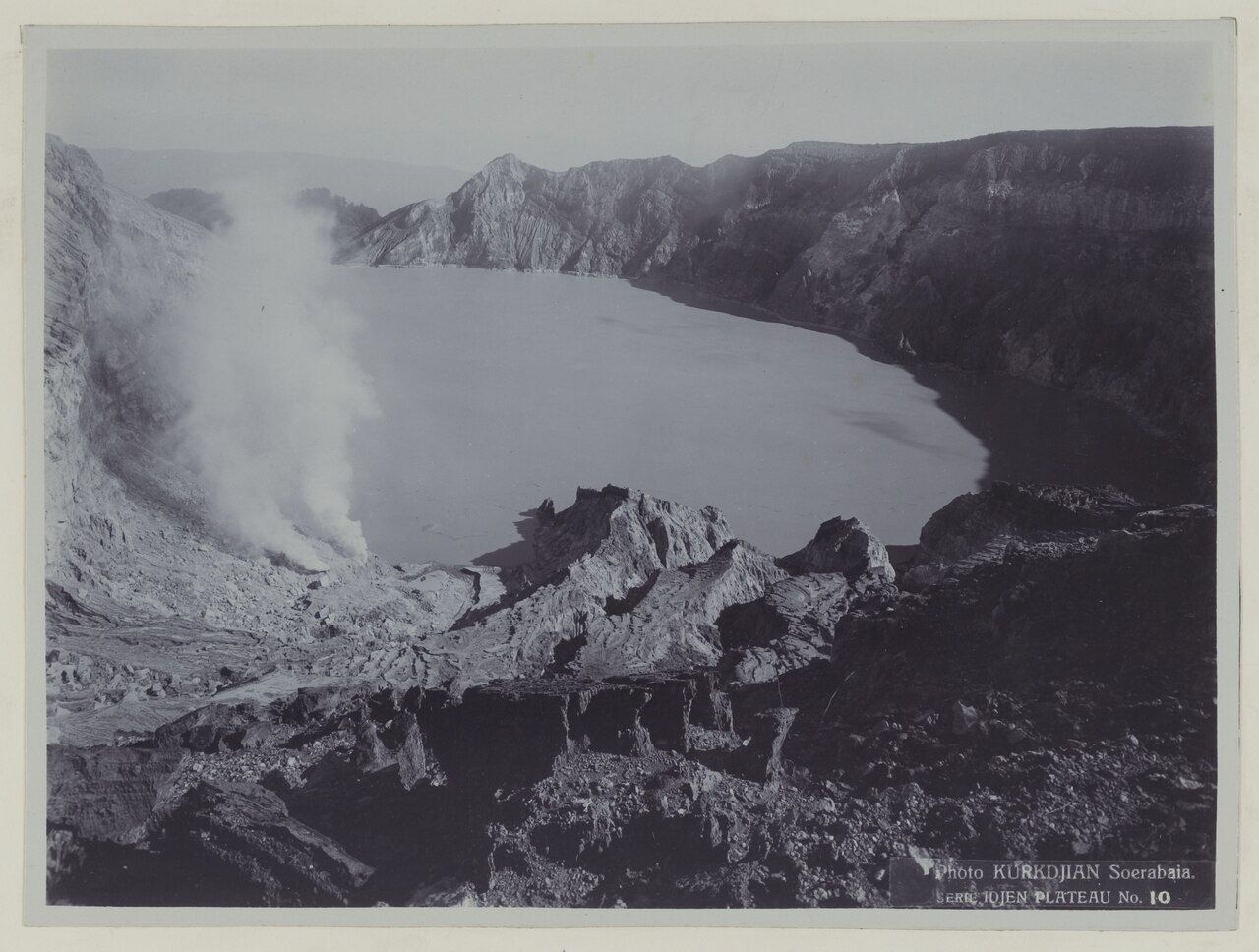
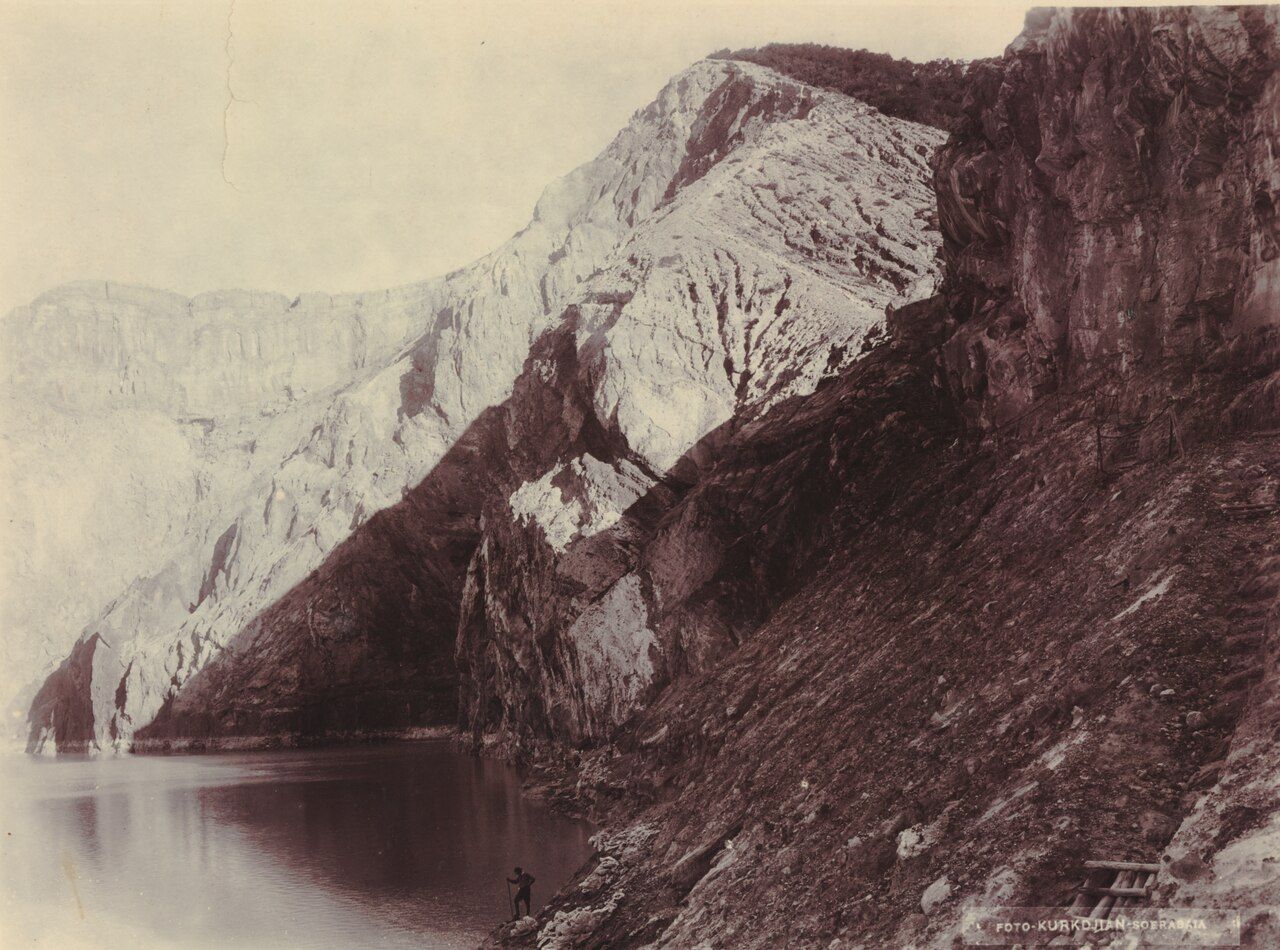
People have been photographing this view for more than a century, and old prints from the colonial period show the same steep walls and smoking shoreline. What has changed is the number of visitors. On weekends and Indonesian holidays the rim can be busy, so a weekday visit is usually calmer. The plateau's dry and wet seasons also matter: the drier months generally bring clearer mornings, while the rainy season can mean cloud, slippery paths and a crater full of mist.
You will also see the sulphur carriers who work in the crater, walking up from the vents with heavy baskets on their shoulders. Give them room on narrow sections of the path and do not photograph them without asking. Their work is explained, with the respect it deserves, in the story on the sulphur carriers of Ijen.
Closures and alert levels
Kawah Ijen is an active volcano, and access is never guaranteed. The authorities close the trail, or restrict how far visitors can go, when gas levels rise, when volcanic activity increases, during bad weather and on certain scheduled days set aside for maintenance. Indonesia's volcano alert levels are revised as conditions change, and a crater that was open last week may be closed this week.
Before you plan the night around a crater visit, check the current status with the park authorities or another reliable official channel, and check it again the evening before. If the trail is closed when you arrive, accept it. The rules about going down into the crater itself are stricter still and change from time to time; at some periods visitors have not been permitted to descend at all.
Practical notes
- Warmth: nights on the plateau are cold, and the rim before dawn can be close to freezing in the dry season. Bring a fleece, a windproof jacket, a hat and gloves.
- Light: a headlamp with fresh batteries leaves your hands free on the steep middle section of the trail.
- Feet: wear shoes with good grip; the path is dusty, loose in places and slippery after rain.
- Water and food: carry enough for the climb and the time on the rim; stalls near the trailhead keep irregular hours.
- Money: carry cash for entry and any services, as card payment cannot be relied on.
- Health: if you have breathing or heart problems, or feel unwell on the way up, turn back.
Coming down in daylight is a different experience from the climb in the dark. You see the forest you walked through, the slopes of the old caldera falling away to the west, and the plateau spread out below. Many people pair the crater with the coffee country and hot springs of the plateau, or continue to Bromo or across the strait to Bali, but the crater is worth the trip on its own.
Back to the crater rim for the next walk.
Photographers on the rim
- CEphoto, Uwe Aranas, CC BY-SA 3.0
- Oakenchips, CC BY-SA 4.0
- Ohannes Kurkdjian, Public domain
- Ben Tubby . Bearbeitet durch Geoethno (aufgehellt), CC BY 2.0
- Ohannes Kurkdjian, Public domain