
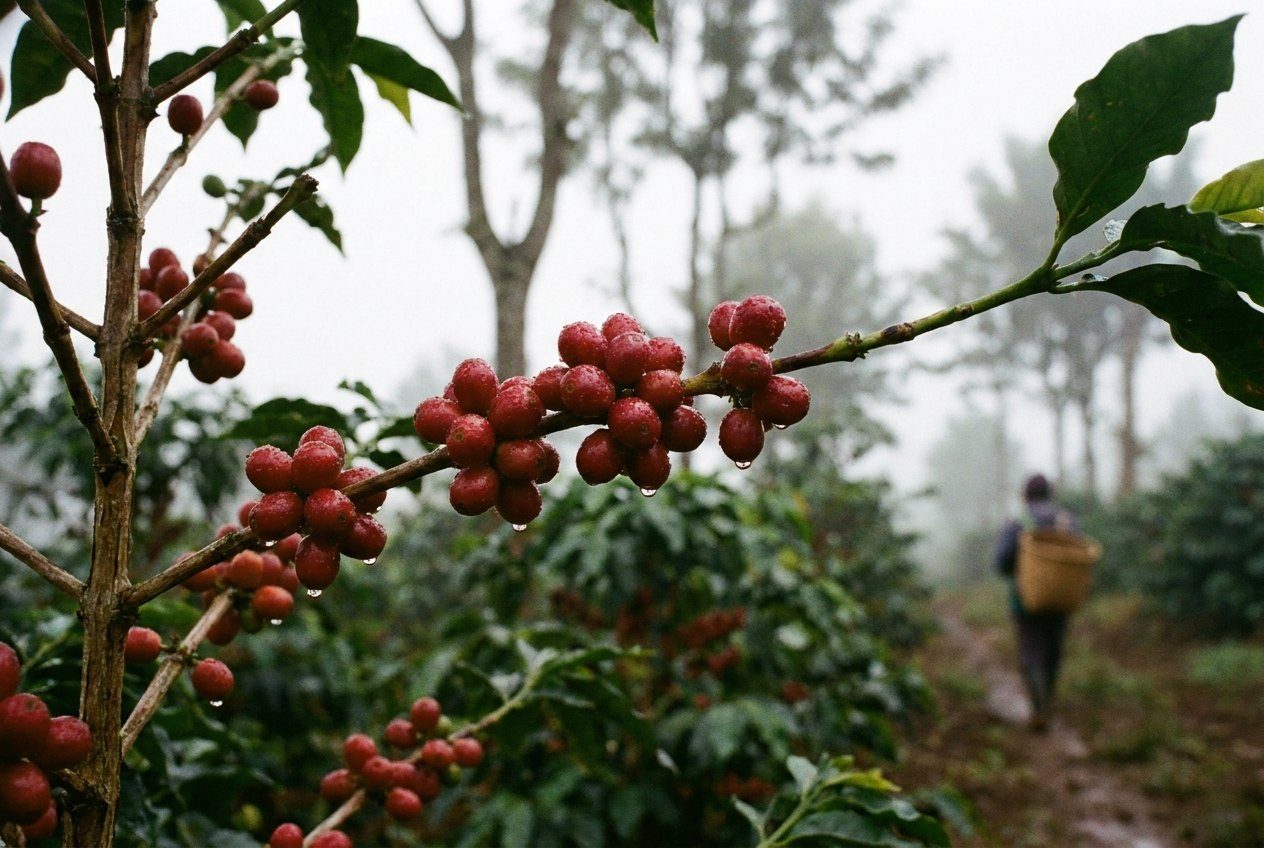
Most visitors cross the Ijen plateau in the dark, on their way to the crater, and see nothing of it. That is a pity. The high, rolling country west of the crater is coffee land, covered with plantations that date from the Dutch colonial period and still produce some of East Java's best-known arabica. Cross it by day instead and the scenery changes completely: shade trees over neat rows of coffee bushes, small villages of plantation workers, river gorges, and warm springs that run beside a cold mountain stream.
Plantations of the colonial era
The plateau was opened up for coffee growing under Dutch colonial rule, when large estates were laid out across its slopes. Several of them survive today under names that will be familiar to anyone who has looked at a map of the area: Kalisat, Jampit, Blawan and Pancur are among the best known. The estates are now owned and run by state enterprises, and the old pattern of the land is still clear, with plantation blocks, workers' housing, processing sheds and estate roads laid out in a way that dates back to the colonial period.
The village of Sempol sits at the centre of the plateau and is the closest thing it has to a town. Around it, the estates spread out over the gently rolling ground between the volcanoes, with the bulk of Mount Raung on the western horizon and the Ijen cones to the east.
Arabica in the highlands
Coffee on the plateau is mostly arabica, which prefers cooler temperatures and higher ground than the robusta grown in many lowland parts of Java. The bushes are planted under taller shade trees, which protect them from strong sun and help hold the soil. Walking through an estate, you see long, regular rows of glossy, dark green bushes beneath an open canopy.
Coffee from the wider Ijen and Raung area has a reputation among buyers and roasters, and the name of the region often appears on packets of Java arabica sold abroad. Much of the crop is processed on the estates themselves, and in the harvest season you may smell coffee drying as you drive past the processing areas.
Driving across the plateau in daylight shows you a different side of the region.
Driving across the plateau in daylight shows you a different side of the region. Between the plantations are patches of forest, open grassland and vegetable gardens, and the higher ground looks across a wide landscape of volcanic peaks.
Picking seasons
The main coffee harvest on the plateau falls in the drier months of the year, when the cherries ripen from green to deep red. Picking is done by hand, which allows pickers to choose the ripe cherries and leave the rest for later. In the harvest season the estates are busy, with workers moving through the rows and trucks carrying the crop to the processing areas.
On the same journeyWhen to go: dry and wet seasonsExact timings vary from year to year with rainfall and altitude. Outside the harvest season the estates are quieter, but the landscape is just as striking, and the bushes may be in flower or carrying green fruit.
Visits to the estates themselves depend on the arrangements in place at the time. Some have offered tours of their processing areas in the past; others are working plantations where visitors are not expected. Ask locally and respect any signs or gates that say otherwise.
The springs at Blawan
Near the Blawan estate, the plateau drops into a river gorge where warm springs flow out of the rock beside a cold stream. The water is heated by the same volcanic system that feeds the crater, and it carries minerals that leave coloured deposits on the rocks. A waterfall drops into the gorge nearby. It is a pleasant place to soak after a night on the crater, though facilities are simple and conditions can change.
The springs are popular with local visitors at weekends and on holidays, so a weekday visit is usually quieter. Bring swimwear and a towel, and take care on the paths, which can be slippery.
Further across the plateau, not far from the road between Sempol and the crater, lies a ring of grassy hills enclosing a shallow basin. It is an old volcanic crater, long since quiet and now covered in grass, and in the green months its curving slopes look almost sculpted. In the dry season the grass fades to straw. It makes a short and easy detour for anyone crossing the plateau by day, and on a clear morning the views stretch to Raung and the Ijen cones.
Villages of the plateau
The people who live on the plateau are mainly plantation workers and their families. Many trace their roots to the island of Madura, off the north coast of East Java, and Madurese is widely spoken alongside Indonesian. The villages are small and practical, with simple houses, a mosque, a school and a few shops, and life follows the rhythm of the estates.
Markets on the plateau are small, and much of the food comes up from the lowlands, though vegetables such as cabbages and carrots grow well in the cool air. Early mornings are busy as workers head out to the estates, and by late afternoon the villages fall quiet again as the mist settles.
Be considerate when you travel through. Drive slowly through villages, where children and animals use the road; dress modestly; and ask before photographing people. The workers on the estates are at their jobs, not on display.
Combining the plateau with the crater
The plateau and the crater fit together naturally. If you approach Ijen from the west, via Bondowoso, you cross the coffee country on the way up and can stay on the plateau before the night climb. Afterwards, the springs and the estates make a good half-day before you head back down towards the coast.
From the plateau you can see the great cone of Mount Raung to the west, an active volcano with its own story on this site. To the east the road continues past the trailhead at Paltuding to the crater, and on down to Banyuwangi. The coffee itself turns up in cups across the region; the story on what East Java eats has more on coffee culture in the towns below.
Cool mornings among the coffee
- The plateau is cool, particularly in the mornings and evenings. Bring a warm layer.
- Roads are narrow and winding, and some sections are rough. Drive slowly, especially after rain.
- Fuel and cash machines are scarce on the plateau, so fill up and withdraw cash before you climb.
- Mobile signal can be patchy in the gorges and on the higher estates.
Coffee country is easy to rush through on the way to somewhere else. Give it a morning in daylight, and it shows you why the plateau has been worth farming for more than a century.
Back to the crater rim for the next walk.